Saturday, March 12, 2011

Alaska Earthquakes and Tsunamies

I had planned to put in a blog about more effects form recent local storms. Well, maybe another day.

The earthquake in Japan has reminded everyone of how vulnerable we are to sudden changes in the Pacific. We in Kodiak live along the Aleutian Trench. So earthquakes are of real interest to us.


The 1964 Good Friday earthquake outside of Anchorage was 9.2 on the moment scale. That was the second strongest quake in recorded history (after Chile's 9.5 in 1960). The recent 2011 Japan one was 8.9.

In our 1964 quake over 10,000 aftershocks were recorded following the main shock. In the first day alone, eleven major aftershocks were recorded with a magnitude greater than 6.0. Nine more occurred over the next three weeks. It was not until more than a year later that the aftershocks were no longer noticed

Fortunately we have lots less people and no nuclear power plants here to worry about than Japan. We only lost 13 people locally and 119-131 total in the 1964 Good Friday quake. Here, people felt the quake, noticed the sea level retract, so the police went out with magaphones telling enough to head for higher ground. As you have see form our pics, we have a lot of mountains at the edge of the water to climb out of harm's way.

The 2004 quake in the Indian Ocean took 230,000 lives. Dense concentration of population and flat ground caused that problem.

Anyway, we do worry about the quakes and the water. We have tsunami warning sirens that are tested every Wednesday at 2 PM. If they sound and it is not that time, get to high ground quickly......because the arrival time of a tsunami is quite fast....faster than he warning systems can detect them, perhaps.

The 1964 tsunami waves reached Kodiak only 30 minutes after the quake started. It was about 280 miles away. That means the waves travelled at over 500 miles per hour! From what I read, tsunami waves travel at up to 670 miles per hour.

Till improvements were made after the 2004 quake, it took about 1 hour for sensors to detect a tsunami....that meant it had already travelled and perhaps destroyed cities 670 miles away. Now they say they can detect it in 30 minutes. So if you are 300 mile form the epicenter, you might get a warning.

In Kodiak the 1964 first of 3 waves arrived within 30 minutes; 2 more came in in the next 30 min to 1 hour. They were 30 feet high. Downtown was gone. All the fishing fleet was gone.

And apparently, this wasn't particularly high waves. I read that the 1755 Lisbon tsunami waves reached 10 stories. The highest expected theoretically are 60 meter, over 180 feet. I didn't know they were that high. And I had felt safe with a house at 119 feet above mean sea level!

Anyway, Friday we got calls form people at 6:30 AM to warn us that at 9-10 PM Pacific time a big quake had occurred in Japan. But form what I read, we were just lucky. If a bad tsunami was coming our way, it would have hit us between 3 and 4 AM.

But, as you can see, quake activity around Kodiak has been quite calm over the last 24 hrs.


So, no need to worry. In the end, though, if it is not the big "C", it might be a speeding car; or being at the wrong place, like a hold up in the lower 48; or maybe just "The Big Infarct".

Someday maybe we'll worry about those things, until then, enjoy what you have around you! The sun is shinning, water's warming...up to 36.5 F !!!! Time to put the kayak in the water???? Any time now!!

Wednesday, March 9, 2011

Stranded after the storm II

Recently, before the Japan tsunami, we talked about boat casualties of a recent storm: three stranded Kodiak boats in one week

Here is another Kodiak boat, stranded on that same week.


Getting off to safety is priority one. Lots of thanks are given to the Coast Guard.

But if you are the captain or owner, your worries don't end there. How do you salvage what's left of your boat. That's easily a quarter or half million dollar stranded on the rocks.

And you have to worry about leakage of fuel. After the Exxon Valdez experience decades ago, the government takes a real close look at who is responsible for any spilled oil and it's clean up.


Now, do you get an idea of why it costs so much to buy Alaska wild caught seafood? But it's worth it in taste and in it's health benefits!

Adrift after the storm I

On a recent week, the Kodiak paper had 3 articles about big , 60 to 150 feet, boats from Kodiak stranded by the weather. That's what happens in rough winter storms: 20 foot seas batter you around.

This barge lost it's tether to the hauling tug. Adrift it went till calm weather allowed a recovery.


Incidentally, when we moved here we asked about getting insurance on our container which would be travelling form Seattle. They pointed out that they are stacked 3 containers tall; and a car may be placed on top of that. Occasionally a container falls off the barge. When we asked if they stopped to recover the container, we got a real peculiar look.

We bought the full insurance.

Thursday, February 24, 2011

Working hard to play

When we moved here we left the tennis stuff in the lower 48. But we were surprised to see rackets at the local sporting good store.

Turns out there are 2 courts in town. And the high school has gotten a tennis team in the last year or 2.

But it's not always easy playing this sports in Kodiak. If it's not the rain, it's the snow.


Maybe shovelling the courts strengthens your tennis serve.

In any case, if they are willing to shovel in order to play, this team is bound for the State Finals for sure!

Saturday, February 19, 2011

A mid-winter's dive

On a January stroll, along the edge of Ft. Abercrombie....

...thought we found two sea otters.

But turns out we were wrong.

No otters, just something odd. Pretty, yes.
But, 25 degree air temperature and 34 degree water!

Till it warms a little more, think we'll go on hikes, or at least hope we stay inside our kayaks.

But, may we recommend, that before you just jump in that water......
visit with these guys......
to get a little local info on our scuba and our surfing.

Then, go enjoy!

Friday, February 18, 2011

After the storm

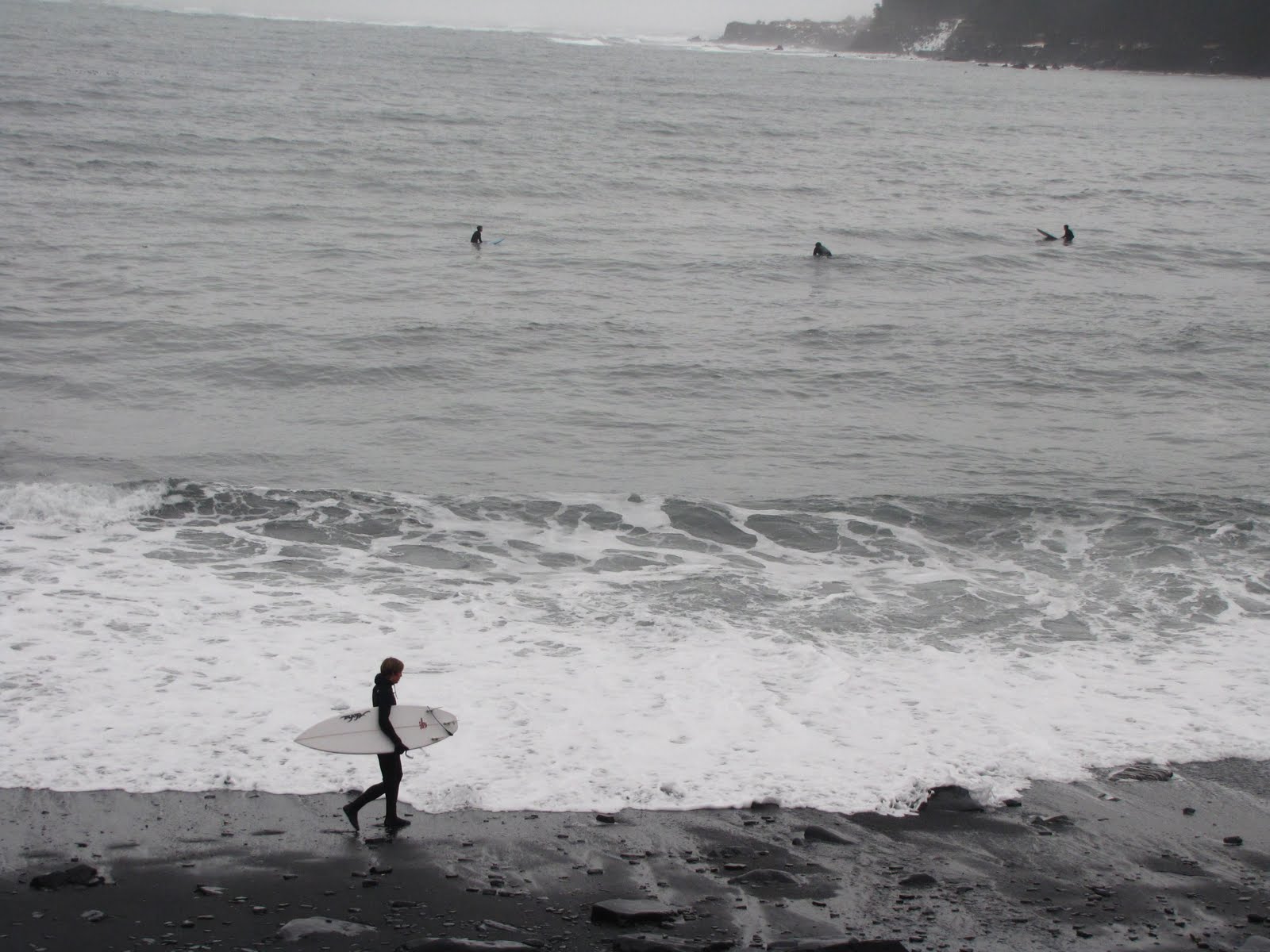
What do you do after a February storm?


You look for a beach with your type of waves.


Run with excitement....


and catch a ride.


Yes, in Kodiak.

Or as some surfer's call it....."the northern-most Hawaiian Island"

Thursday, February 10, 2011

Winter takes it's toll

We enjoy watching eagles in the winter. There are lots of these guys around: 600 breeding pairs on the island says the Internet. And that leaves out all those juveniles we see around town, looking for their winter meals.

But, winter is stressful on our animals. Last week the newspaper reported that a kayaker found 3 dead eagles on an island right here in Kodiak's St Herman harbor! Another was struck by a car, and a fifth one was electrocuted. All in one week!

In January another one was electrocuted in downtown Kodiak...and that was a famous eagle. The oldest bald eagle on record in Alaska: 25 years old. It survived the Exxon Valdez oil spill effect in Kodiak.

Seems like a lot die. Last year we lost about 33. We might be seeing more, but that is because people are learning to report them when they find them.

If they are dead, Fish & Game ships them frozen to Denver, where they store them and distribute them to natives for religious ceremonies. As common citizens, we are not supposed to even touch them. Leave them as they are and let F & G pick them up. Those are the rules.

And if you find a weak and injured one, don't try to help it. They are quite dangerous to approach, even if they look weak to you. When laying on their back they are particularly menacing: their claws are then in perfect position to tear you face and chest. Beware! We know people who have seen those hurt by such animals.

Any way, if F & G gets a sick one, they send it to rehab off in Anchorage. That is where the one on the small picture on the left went, less than a week after I took it's picture.

To read the article about the resent lost ones, copy and paste this address on your browser:

http://www.kodiakdailymirror.com/?pid=19&id=9551

Anyway, here's one juvenile sitting on a broken pier. See the wind lifting his head feathers? The white head is starting to show under the brown juvenile feathers. His body is as wide as a telephone post! I think their feathers are more "fluffy", making them look wider and bigger than the adults.

But it still looked cold. 20 degrees and over 20 mph winds. Not moving, just conserving energy.
Don't worry. He's young. He'll make it.

Friday, February 4, 2011

Ft. Abercrombie walk in the snow

The day after the "walk" down Island trail, we took a walk around the lake in Ft Abercrombie. There is still snow on the ground and you have finally burned up some calories after being cooped up with those long winter nights.

So, today take a real leisurely walk around one side of the lake at Ft Abercrombie, go to the ocean, and return on the other side of the lake.

Hope you enjoy what there is to see: ice skaters and ice fishermen on the lake; cormorants; an eagle at the sea shore. You might even see a sea otter. How about fishing boats working in the cold?

On the way back, pay attention to the moss on the trees. Their persistent green color gives you a "warming" sensation, even on the snowiest days.

You never know what you'll see. So get out and enjoy whatever there is.

Once the snow stops, get out and enjoy..

The Lower 48 has been cooped up for a week with bad weather. It has now stopped.

So do what we do in Alaska. Get your 14 year old lab and that pesky little rat dog on their leashes. Get your IPod loaded with a nice beat of Spanish classical music.

Now get out and enjoy what's around you!

We'll climb to the top of the hill and and follow the creek from Island Lake down to the ocean.

After being cooped up, you'll thoroughly enjoy the exercise.

Thursday, February 3, 2011

Kodiak Coast Guard saves the day... for a distressed vessel in the Atlantic


A fishing boat, taking on water beyong what the bilge pumps could pump, called out for help. No it wasn't local; their accents seemed awful strange. It was a Southern accent.

And it was from over 4,000 miles away. Off the Florida Coast in the Atlantic Ocean.

No one else heard it. Kodiak listened and got its coordinates. So USCG Kodiak called Florida to try and reach the vessel. A Navy ship was 12 miles away and to the rescue they went. The Navy Times reported the rescue, but appreantly never mentioned it was initiated form over 4,000 miles away.

Way to go, Kodiak! Always keeping those earphones on!

Apperantly radio transmissions can bounce off the ionosphere, skip the local air and he heard far, far away.

To hear the transmission about it, go to KMXT, the local Public Radio Station in Kodiak. You can hear the conversation in the background and their report on the story. Copy and paste the following on your browser:

http://www.kmxt.org/index.php?option=com_content&task=view&id=2462&Itemid=2