Saturday, May 21, 2011

Ready for Kayaking

Weather was great for 1 week. Lots of people put their kayak on their cart tops, ready to go.

Then the rains came back.

We are just waiting for the seas to calm down so we can put the kayak back in the water.

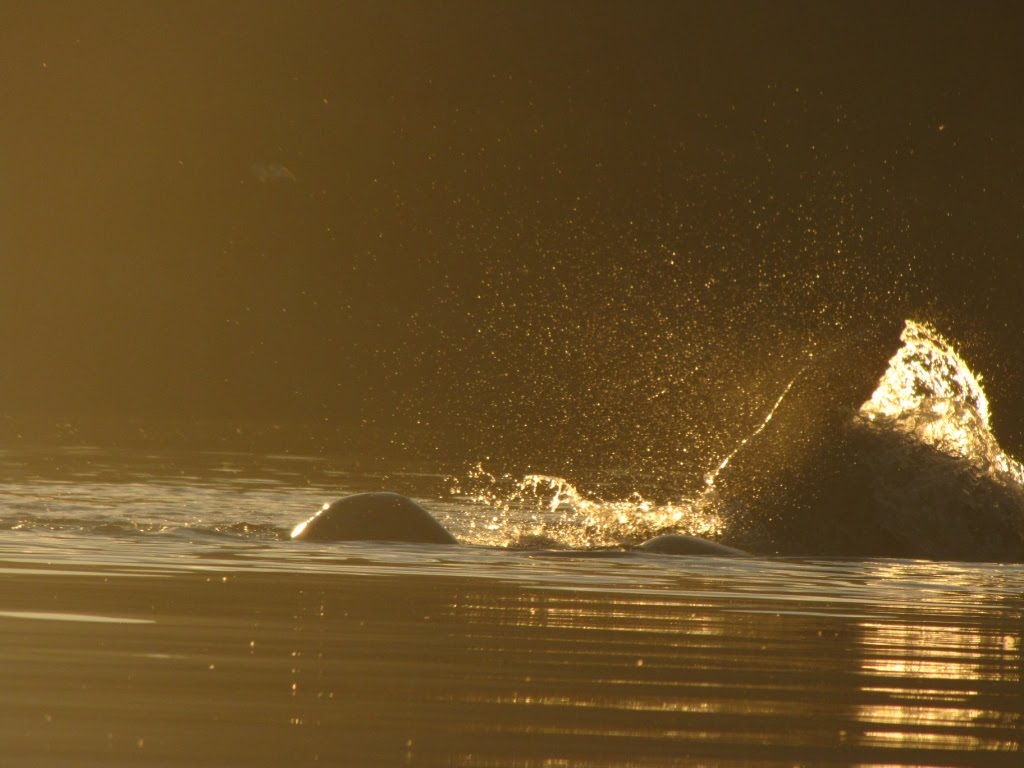
Here are some pictures from a prior June, paddling along the kelp. Mill bay's houses are in the background.

See why we like it so much?


It can be so quite out here. Only the sound of your paddle moving the water and the fluttering of the bird's wings as they fly by.

Not bad for entrainment at 10 PM, and a good way to relax before bedtime.


Here is a picture of kelp's leaves, in case you've never seen it.

Wednesday, May 18, 2011

One more big bird

In Kodiak you keep sane during the winter wondering about things you guys in the lower 48 have no time to think about. Before you know it, you think it's worth studying.

One book I read was on identifying birds. They recommended you figure the size and weight of a bird you know and compare any new ones to those characteristics. Then you apply it's color scheme, beak, etc, etc, etc and figure out what it is.

So, while vacationing in the lower 48 and driving for miles and miles through the Southwest, I found myself comparing those birds to our Kodiak birds.

The lower 48 buzzards are interesting to me. A recent comparison chart on our blog showed that it is not really much less in wingspan than an eagle.

But why is it that every time a little wind comes up, those buzzards seem to suddenly loose their balance and tilt 15 - 30 degrees. Not so for our eagles; it takes a mighty gust to make them tilt much.

I've figured it out: they have a very slim trunk, compared to eagles...probably 1/3 their weight. And that explains why they get buffeted all over the place by a little wind!

Anyway, I know you are getting tired of our bird stories. So we'll leave that subject with 2 pics of one type of Kodiak seagulls.


If you have nothing else to do, try to figure out what kind of gull this is.

Look at the color on its legs and beak. Look at its size.

But, for me, its a pretty darn big compared to an 18 wheeler's tire.
Don't you agree?

Maybe next winter will be a good time to classify it further.

Monday, May 16, 2011

Big Birds

We used to think our eagles were really big birds.

We've shown you pictures on the blog of a local Bald Eagle sitting on a whale bone as we accidentally passed by it's side. It could have reached out and pecked at out heart! On another occasion we returned from a hike to find one standing on a guard rail by the side of the road. It could have reached out and eaten our eye balls. (No, we are not stupid; we didn't stop to photograph one that close.)

Well, at the Grand Canyon we met the California Condor. Those guys have a 9 1/2 foot wingspan. Here's a ranger holding one of its feather.


It's a good thing condors only eat dead things!


We'd like to pick up an eagle feather and photograph it for comparison, but that is not legal. We'll just tell you that they are longer than the length of a man's forearm and hand combined (or longer than the length of a humerus).

So, here are a few eagles we saw this January, for comparison.


Theirs are as wide as a semi.
Ours are not as wide as a pick-up truck.

But, ours are a lot cuter.....

...even when they get old.

Tuesday, May 10, 2011

Summer is on the way!

Sunday we woke up to a warm and toasty 51 degree with full sunshine!

50 degrees is kind of warm, though. Short sleeves all day and wondering where the shorts are stored.

What a day! Took the dogs for a hike. Even the 15 y.o. Lab was ready to go.

Then: Wash & wax the car; fix the summer bike; and go kayak at 8 PM. Back home by 10 PM, still in the daylight!

Had to close the curtains to get to sleep!

Summer in Alska is like being hyperthyroid for 4 months of the year.

We love Kodiak.

Monday, May 9, 2011

Changing birds

Like all Kodiak people, we go on vacations. The recent one was to Canyon de Chelly and then to the Grand Canyon, both in the Arizona sun!

Needless to say that we kept an eye out for birds, to compare them to ours in Kodiak.

Sure there were ravens there. They are about 1/2 to 2/3 the size of ours. Here a a few pics of the Arizona birds at dusk and daytime.


What was interesting was that at the unpopulated Canyon de Chelly they always flew in pairs. At the Grand Canyon (where there where more people), there seemed to be many more solo fliers.

Bird people talk about how ravens here fly in pairs. But, I must say, not as common as in the desert. I have come to the conclusion that the more civilization there is, the more independent birds are.

And an article I read in the Anchorage or Fairbanks paper backs me up. According to that, about 30 years ago they put some sort of trackers in Fairbanks ravens. It turned out they flew about 40 miles every night to rest in their nests. In the morning, they would fly back to the city and eat off civilization.

But apparently that is changing. Currently, according to that article, many ravens just seem to stay in the city for their entire life. I guess home is where the food is. And that birds can change their habits.

But people at least seem to miss their home and the things they know. Here is a pic of a "dog" and "bird" that someone made from the snow at the Grand Canyon. Guess they missed their pets. Kind of cute, don't you think?


No, I know what you are thinking. But, that's a real picture, not a Photoshoped one.

Friday, May 6, 2011

No surprise: Kodiak is a sportsman’s paradise

Kodiak, it turns out, is a great place to live if you are a sportsman.

Recently, Outdoor Life magazine released its list of the 200 best cities in the nation to live as a sportsman, with Kodiak at No. 4 and Old Harbor (a village on the island) in the top 100.


Read Wes Hanna's article in the Kodiak Daily Mirror newspaper-


http://www.kodiakdailymirror.com/view/full_story/12856390/article-No-surprise--Kodiak-a-sportsman%E2%80%99s-paradise?

Saturday, April 30, 2011

One more "whale" blog


Actually, these are Shamu's or Willy's relatives: Orcas or Killer Whales. They're really just huge mean dolphins or porpoises because they have teeth.

There are about 3 groups with special things they like to eat. And apperantly they have been doing it for so many hundreds of years, that the groups are genetically identifiable as different.

"Transient" ones live far out to sea and like to eat their smaller porpoise cousins; but a recent article in Alaska Magazine talks about how some gang up on giant Gray Whales to feast on them. Other groups or pods like to eat just salmon and other fish. And some like to stay close to land and eat local sea life: otters, seals, and sea lions are specially tasty to them.

This group sure likes to come into the harbor in Spring. Our sea lions take notice. They wake up, jump in the water, and a few "brave" ones swim out and start barking at them...similar to what they do when I get too close to them when kayaking.

Here some sea lions I photographed last Autumn, coming to "protect" their water.


So, if you where a whale with teeth and saw a 500 to 1,000 pounder like this come up to you and bark in you face, what would you think?

Apparently, Orcas think, "Lunch!".

This reminds me of my favorite quote form the Forest Gump movie:
"Stupid is as stupid does!"

Monday, April 25, 2011

Are these guys illegal?


Talking about whales, while in vacation in Mexico I struck up a conversation with a local. Discussions ran to where we where form.

Here is one of his comments: "You know, those whales you like so much in Alaska are born just outside of my city. How come you don't consider them illegal aliens?"

I tired to change the subject. "Good thing they don't travel through Arizona!", plugged in the Mexican.

Anyway, can you tell which is the Mexican and which is the Kodiak whale?


Whales close up

Above I included a close up of a whale's tail, taken by Pam Foreman, not me!

I think I mentioned last Summer that on July 4th I looked out my window, saw a whale in Mill Bay and decided to go get some close up pictures.

Got my kayak and paddled about 100 yards form where it was. Suddenly I see its tail come out of the water. It was as wide as the length of the 12 foot inflatable Zodiac boat that was fishing for salmon.


This reminded me what the natives say about another big animal: "You must respect the bear!" They say this over and over again.

When I saw that tail, I suddenly re-interpreted their comments to mean: "They're a lot bigger than you are. So keep out of their way!"

A Killer Whale is 9 tons. Gray Whales weigh 30 tons. My kayak weighs 59 pounds.


So, I paddled back to shore and decided to let others photograph them close up.

Sunday, April 24, 2011

Kodiak's Whale Fest 2011


We've just returned from travelling in the Southwest. Got to get a little sunshine sometime, you know.

So we missed out on the 15th annual Kodiak Whale Fest. It is about 2 weeks when the whole city gets excited about the return of the Gray Whales to our waters. Lots of lectures, educational movies, hikes to points to see the whales, and even art shows related to sea life.

Take a gander at the reported whale sightings: http://kodiakwhalesightings.blogspot.com/

and a website talking about what is going on:
http://www.whalefestkodiak.com/Home.html


Here is this year's emblem:
designed by 10th grade art students at Kodiak High School:


See you here next year, for the 2012 Whale Fest!