A very happy ending occurred after a grandfather and grandson went kayaking last week. Embarrassing, but happy.
A 60 year old grandpa and his 13 year old grandson were kayaking on Mission Beach when the current pulled their anchored kayak into an unstable position and flipped them over. Their attempts to remount their kayak were unsuccessful. 49 degree water can do that; you quickly get uncoordinated enough to fail at doing what you know you have to do.
Fortunately lots of folks heard their calls for help. Some called 911; other climbed in whatever boat was available and off they went to the rescue. And successful they were. The volunteers had them on shore by the time the Harbor Master's boat and the ambulance reached the beach.
What a memorable Father's Day that was! Hope yours was less eventful.
So, what do you do when the days get long? Here's what we did last Sunday, about a week before the longest day of the year.
If you are lazy like me, you sleep past the 5:15 sunrise. Get up at 7 and load the kayak. Discover that the tide is out and you don't want to carry the kayak that far to the water. Check out the sealife at low tide: 4 inch clam shells, red starfish, red jelly-like invertebrates hanging from the under side of the rocks. Then walk out to the Kitywake rookery and watch those tiny sea gull like guys suddenly fly off together, about 100 at a time, and then return to their perch.
Then its time to go up Pillar mountain to see the "green-up" along 3 Sisters Mts. Time for lunch. Tide is coming in. Kayak out Mill bay. Play with big swells left over form Friday's storm.
Answer phone calls. Wash the cars, mow the lawn, eat dinner. Go to work to clean up stuff form the week end. Come home at 11:45 PM, with still enough daylight so cars are barely turning on their lights.
Close the black out curtains and try to get some sleep before daylight returns, around 4:30. Soon its time to get up and enjoy another day!
People in the interior of Alaska get excited about the "Break-up" of the ice from the rivers.
We get excited about the "Green-up". That's when the mountains change to green...as if a sheet was being pulled and the green shows up...marching up the side of the hills. The dramatic change seems to happen over a day. People who work in offices facing the hill say that if they look up at the mountains every 2 hours when it is happening, they can actually see the green has marched up the side of the landscape.
Here is a picture of Pillar Mt as one would see it form the side of downtown.
The others are form top of Pillar, looking towards 3 Sisters and White Sands Beach at the end of the road system. Once Summer arrives, we should have green to the top. And then the shade will change to a dark, deep green. That's why they call it the "Emerald Isle".
If you have nothing to do, take a 2 minute look at prior Monday's slide/video of our kayaking out to a bird island for a picnic with the gulls. Not bad for a mid day picnic.
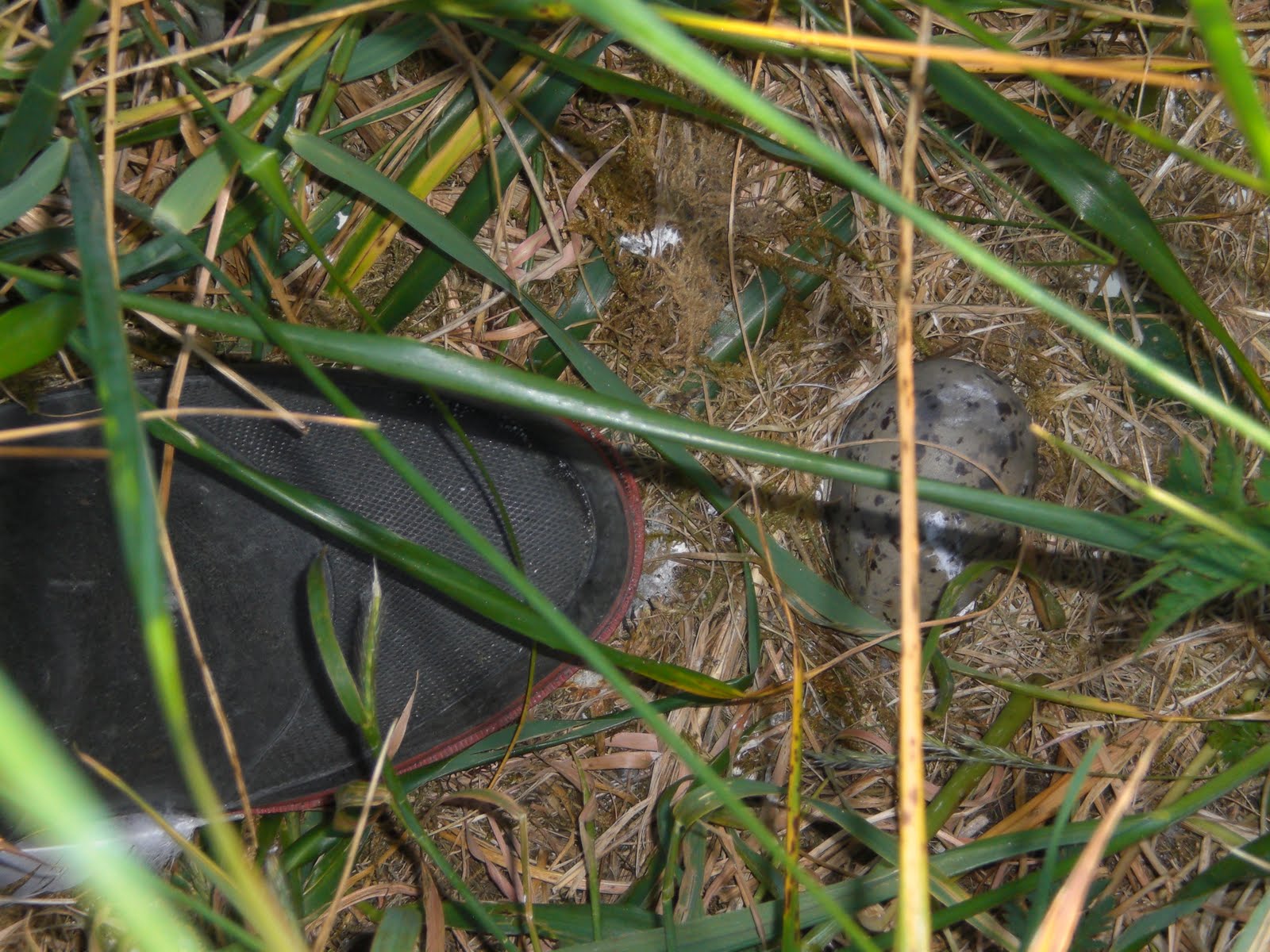
On my pictures, note that the eggs and the baby bird's feathers have a similar color pattern. It must be good camouflage.
They say a male often return to mate with the same female. Seems birds are more faithful than mammals. And more nurturing. Both parents incubate the eggs.
When they fly off to eat and they spot another species’ eggs, they occasionally pick up a rock or shell and drop it form the air to crack the egg open. Then it is protein feast time.
So, next time a gull poops on your head, don’t get mad. Think of it as their target practice.
Kodiak is the second largest US port after Dutch Harbor (also here in AK), whether in either amount of fish or cash generated form fishing.
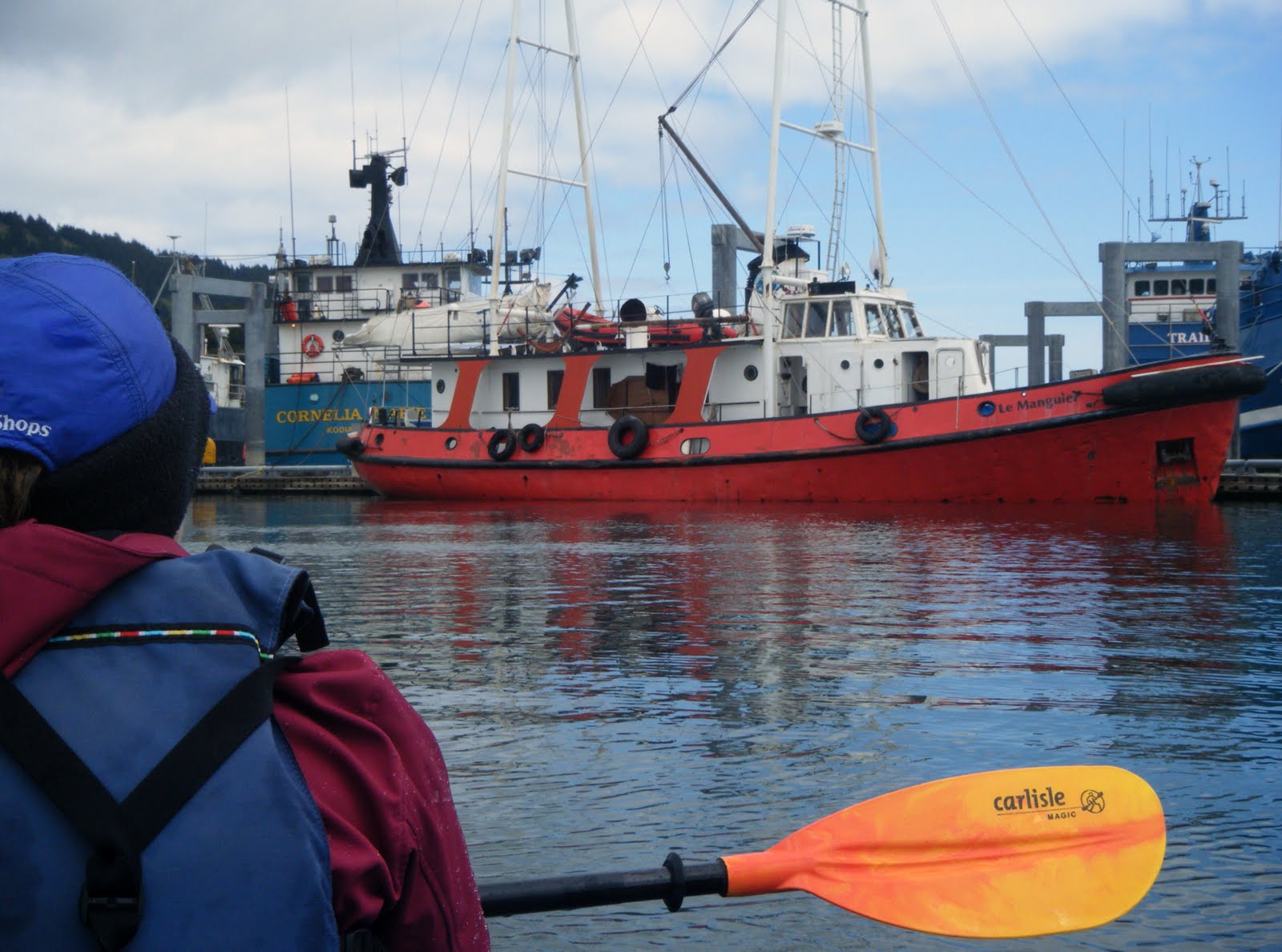
So, it is natural to assume that some famous ships come here. In this picture from Monday's kayak outing, you can see 2 of them. The Cornelia Marie (at the corner on the left)is famous because of its appearance on the TV show "Dangerous Catch". Unfortunately, its famous captain has recently passed away at 53 form a stroke, according to the paper (No HIPAA issues in that statement).
But the other ship should be considered of perhaps even more importance. It is Le Manguier. It's one of the first private ships to cross the Northeast Passage since the ice has recently broken due to warming. From Europe, across the Arctic Sea north of Russia, to the Bering Sea, and then the Pacific Ocean. A route which might save many miles for sailors...if it stays open long enough to make the trip before the weather gets bad at the other end!
They started in the Spring of 2009 in Corsica, south of France, with a captain who was a repairman for ships. He bought an old tug boat, replaced it's powerful engine with one that would let him travel at 9 gallons per mile, and put masts to bring up sails when the wind was behind them, to increase efficiency to 7 or 8 gpm. Put solar panels, and got a paint job with a research paint that should be less toxic to fish, etc, etc, etc to make it more "green".
The plan was to pack it with enough food for a year, have a total of 10 people on the ship for each leg of a 9,000 nautical mile trip to end in Tokyo. There would be scientist and artist to research and paint and "educate" the locals about more efficient travelling at each port they docked at. It sounds like a great trip to experience what few have seen.
But, they mentioned there were times when the open water (free of ice) was only a hundred yards wide ....not much of a sea lane. And once they left the Arctic, the weather in the Bering Sea was so rough, that they sailed to Sand Point instead and stayed at that small Alaska village over the winter. In May they were invited to speak at Crab Fest here in Kodiak. And here they are, telling us about their trip, their conservation efforts, and enjoying the local stuff just like we are. Now with the great Alaskan Summer, no one is in a hurry to leave.
If you would like follow their progress and comments, or send them your support,check out their site at http://www.navirelemanguier.com/Bastia_Tokyo1a.html
We, on the other hand, will continue to paddle our kayaks at "infinate" miles per gallon (excluding, of course, the food and beer we ingest when we return).
Tuesday we went on a 5.5 mile hike to Termination Point. Here's a picute of the stating point at "White Sands Beach". They call it that because if the tide is really, really low, you can see some white sand. Otherwise, it is Kodiak's typical black beach.
Isn't the grass getting "green"? ...and it's only June 8th!
Towards the end of the hike, this is close to where you are heading.
June 8th, at 5:15 AM. Preparing for a wonderful day!
Notice how the rising sun is quickly moving from the East towards the North (to your left) on the more recent picture, as the longest day of the year approaches. And, until then, days are still getting longer and longer. We like that.
I am sure your newspaper reported that 897 or some such number graduated from High School this May.
But did it have a special insert with a picture of each of the graduates and comments about where they were going or what they would do different if they had High School to do again?
How about pictures on the front page of the graduates... and sometimes even the middle school graduates.... form villages whose entire population might be 42 to 220 people?
Our's did! Here are some our graduates form village schools.
They are proud but relaxed. Did you notice that the girls in the middle picture did not wear shoes? Is it a "protest" or is it just so warm as the summer approaches?
Yes, here I go again: spouting off all the clutter I gather from the Internet and the local lore. Today it is about the birth of Seals and Sea Lions. They are quite similar, so I will just group them together.
And like the blog on slugs, this might be too descriptive for many readers. So beware about reading further.
Most of the real interesting stuff is form the locals who used to hunt those creatures...when it was legal as late as the 1970's. If you get a chance, take a look at Andy Nault's book Staying Alive in Alaska's Wild and Steve Decloux's Two Tales of Old Kodiak. (Sorry, this program won't let me underline book tiles, so I just put them in italics). It'll give you a real insight into the challenges they faced against the weather, running among so many animals....and what went through their minds as they hunted and then prepared their greasy hides.
These guys went hunting for the young seals from May through August along Kodiak's many islands. They'd boat to a place they knew large population of seals came to give birth, such as Ugak island or Tugidak island at the extreme south of Kodiak. There they would find 200, or 500, or up to 10,000 seals on a beach that might be 4 miles wide at low tide but only yards wide at high tide. Can you imagine the stink of so many animals? ...and many giving birth!
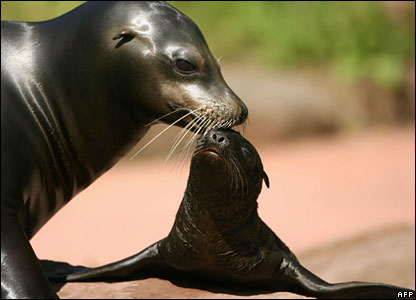
The Internet has pictures (like those above) of mother caring for their young or barking at intruders who try to approach their babies. But that is not always the case. Many moms just simply abandon their young and go back out to sea to eat instead of nurturing their babies with their 35% fat-containing milk.
Males take control of a geographic area and fight other males to keep them out of their harem. Any female in their geographic area is "mine". Females are constantly approached by the big males for "special favors". Once they mate, there goes the maternal instincts. And no orphaned seal or lion is taken in by another mom. No way.
Starving babies are too weak to run and, with no mom to fend off attackers, these are easy prey for the hunter. One smooth swing to the head with a short club or a kid's baseball bat and the abandoned seal's slow path to death comes to a quick end.
Even without the human hunter, if mom is not there to take them to the water to cool off, death is on its way. In 60 degree weather, overheating fat makes the skin and fur break open. Eagles attack. Unfortunately my wife made me take out the description of how that happens. Anyway, that is bad for the seals, but food for the eagles and their babies.
In short, over 50% of the young ones never make it to adulthood.
After a few weeks, education begins. Once the babies have gained about 35 pounds, 1 out of 12 moms stay with a group of babies as the rest go hunting for their own food and to bring fish back to their own babies. The "Nanny Mom" start pushing her group towards the water. First it is once per day. Then it is many times per day. Once she starts, she will nudge, and push and even bite the group to get them to move as a herd into the water. They get to be quite qick; and this helps save them. When eagles or men approach, the Nanny Moms get their gang into the water in a hurry. The weak or slow ones don't make it. That is natural selection.
Under public pressure, Seal and Sea Lion hunting was terminated by law. Even natives are limited in that they cannot sell the skin. Yes, natives can sell seal products if made into works of "art", but there is just so little maket for that. So the number of kills is now minimal. In the 1980's rangers reported the total number of surviving seals increased significantly. Since then it has again decreased tremendously.
The old hunters claim it is because we have eliminated a natural force (the hunter)that had been helpful in culling out the slow from procreating their weak genes. Now the killer whales and other forces are culling them out. The hunter were just part of nature. That's their story. And they're sticking to it.
That is perhaps true. But when you kayak by a seal and they stare at you with those huge puppy dog eyes, you just want to take that seal home with you. But not so for Sea Lions. They are big; they scare you by swimming around your kayak and threatening to tumble you over. No way. It is they who want YOU!
PS1: The wife refuses to take any blame for this blog (and made me eliminate the descriptive, scientific information). PS2: The pics above are off the Internet; I've never been that close to baby young seals and sea lions. PS3: If you want to re-see a Sea Lion Rookery on a cliff, check out my last year's YouTube video which I took form a boat(and which you might have seen on this blog before):